Our Certifications — 11 International Quality Standards
Nutriley Healthcare's manufacturing facility holds 11 certifications from Indian and international regulatory bodies — covering quality management, food safety, medical devices, halal, kosher, and US/EU market entry.
Your Brand's Quality Guarantee Starts Here
When you manufacture with Nutriley Healthcare, you inherit the credibility of 11 international quality certifications. These are not just plaques on a wall — they represent systematic quality management, documented processes, third-party audits, and continuous improvement.
For your brand, this means: products that can be listed on Amazon India and global platforms, imported into the USA, UK, and European markets, and sold through regulated pharmacy and healthcare channels without regulatory challenges.
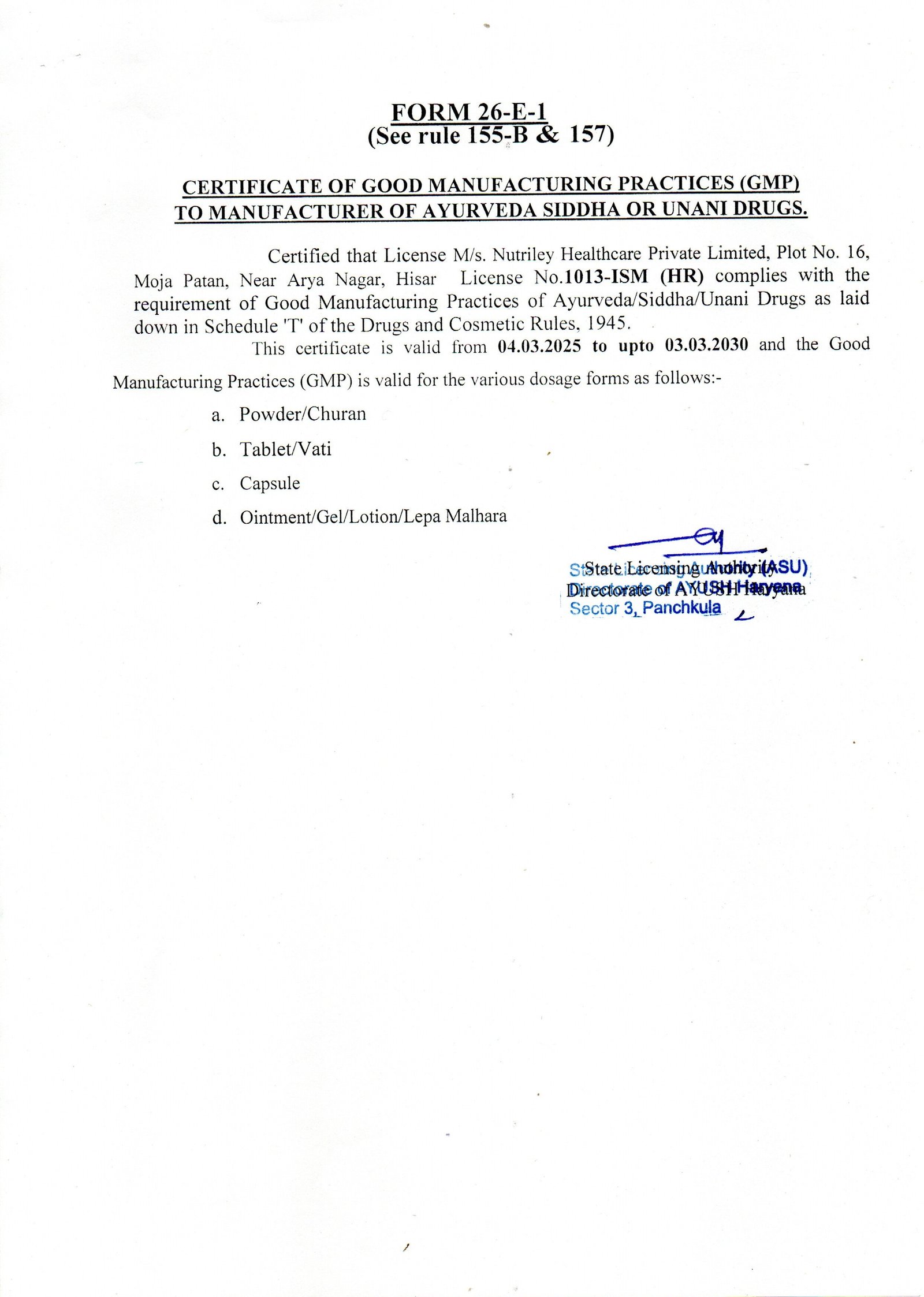
All 11 Certifications Explained
What each certification means, what it covers, and how it benefits your brand.
GMP (Good Manufacturing Practices) is the foundational certification for any pharmaceutical or nutraceutical manufacturer. It governs the entire production process — facility design, personnel hygiene, equipment qualification, raw material testing, production controls, and batch documentation.
ISO 9001:2015 is the world's most recognised quality management standard, used across all industries in 170+ countries. It establishes a framework for consistent product quality, customer focus, process improvement, and documented quality management systems.
ISO 13485 is the quality management standard specifically for medical devices and related products. For nutraceutical manufacturers, it demonstrates that quality systems meet the requirements for medical-grade production — a significant trust signal for clinical, hospital, and healthcare institution clients.
HACCP is a systematic food safety management approach that identifies, evaluates, and controls hazards that are significant to food safety — biological, chemical, and physical. It is a proactive approach to ensuring food products are safe throughout the production process.
FSSC 22000 is a globally recognised food safety management certification that combines ISO 22000 and additional sector-specific programs. It is recognised by the GFSI (Global Food Safety Initiative) — the gold standard for food safety certification accepted by major global retailers.
FSSAI (Food Safety and Standards Authority of India) licence is mandatory for all food business operators in India — including manufacturers of dietary supplements, health foods, and nutraceuticals. Our Central FSSAI licence covers all product categories including functional foods and health supplements.
Nutriley Healthcare's facility is registered with the US FDA as a food facility — a mandatory requirement for any manufacturer exporting food, dietary supplements, or nutraceuticals to the United States. FDA facility registration allows our products to legally enter the US market.
The CE mark is the European Union's conformity marking for products sold in the European Economic Area. For medical devices and certain health products, CE certification demonstrates compliance with EU safety, health, and environmental requirements — a mandatory requirement for EU market entry.
AYUSH (Ayurveda, Yoga & Naturopathy, Unani, Siddha, Homeopathy) approval from India's Ministry of AYUSH and related state licensing authorities is the specific regulatory approval required for manufacturing classical Ayurvedic medicines and proprietary Ayurvedic products in India.
Halal certification confirms that our manufacturing processes, raw materials, and finished products comply with Islamic dietary laws — free from pork derivatives, alcohol, and other prohibited substances. Essential for the global Muslim consumer market which represents 1.8 billion people.
Kosher certification confirms compliance with Jewish dietary laws — strict standards for ingredient sourcing, manufacturing conditions, and cross-contamination prevention. Kosher-certified products are accepted by both Jewish consumers and, increasingly, by a broader consumer base as a premium quality signal.
How We Maintain Certification Standards
Certifications are maintained through continuous quality practices, not just audit preparation.
In-House Laboratory Testing
Our QC laboratory tests all incoming raw materials, in-process samples, and finished products for identity, potency, purity, microbial limits, heavy metals, and pesticide residues — using HPLC, TLC, GC, and ICP-MS instruments.
Batch Documentation
Every production batch generates a complete documentation trail — Batch Manufacturing Record, in-process check reports, QC test reports, yield reconciliation, and Certificate of Analysis. Batch records are retained for a minimum of 5 years.
Annual Third-Party Audits
All certifications are maintained through annual surveillance audits by accredited third-party certification bodies. We also conduct internal audits twice yearly and engage pre-audit consultants to ensure continuous compliance readiness.
Stability Studies
Products undergo ICH-compliant stability testing at both accelerated (40 C/75% RH) and long-term (25 C/60% RH) conditions. Stability data informs shelf-life claims and ensures products retain potency throughout their labelled shelf life.
Supplier Qualification
All raw material suppliers are qualified through our vendor assessment process — including facility audits, quality agreements, and sample testing. We maintain a master vendor list and re-qualify suppliers annually to ensure consistent raw material quality.
SOP-Driven Operations
Every process in our facility — from gowning procedures to equipment cleaning to batch release — is governed by written Standard Operating Procedures (SOPs). All production staff are trained on relevant SOPs with documented, signed training records.
Markets Our Certifications Cover
Our certification portfolio covers the four major markets where our clients distribute products.
Need Certification Documents for Your Import/Listing?
We provide full certification copies and declarations with every order. Request now.